Video Guides
-
 • 5/26/26
Hybridizing Dragon Fruit - Evaluating Your Hybrids
Hello dragon fruit enthusiasts! This is Jay, with Hybridizing Dragon Fruit, where we teach YOU how to make your very own dragon fruit varieties! Today’s video is one of THE most important steps you need to take before sharing your creations. We are going to talk about: Evaluating your hybrids! And by the END of this video you are going to know all the tricks of the trade to ensure your varieties come out, absolutely… AMAZING!
In order to ensure you are creating only the highest quality hybrids, your potential variety must pass a number of rigorous tests before it’s ready to be distributed to growers everywhere. So, when is the right time to start evaluating your new hybrids? Well you want to, right from the start, when your seedlings are only a couple months old. Now is going to be the best time to sprout as many as you can, as it will take the least amount of space when they are this size. What you are looking for at this stage, are outliers that display unique qualities.
But before we begin, it’s important to remember that in order to properly evaluate your seedlings, the growth conditions have to be identical. That means that some of the seedlings in your setup cannot get more light than others, be at different temperatures, or receive more or less water or nutrients. Differences in any of these factors will skew the results too much to make any reliable observations about phenotype (the expression of a trait).
Identify those that seem to grow the fastest. These will be the priority when at the seedling stage. Those that display incredible vigor should be tested to see if this is sustained vigor (the gold standard) or simply temporary vigor. If you grow out enough seedlings, you might even get lucky and find one with a meaningful expression of ‘hybrid vigor’, which tends to be a rare occurrence.
While seedlings often times present larger due to variance in growth rates from slow to superior, those with extreme ‘hybrid vigor’ can be noticeably larger than their siblings. Because this expression is such a rare occurrence among seedlings this is more of an icing on the cake situation, rather than something you make a growing requirement. As this is not guaranteed to happen in even extreme sample sizes, nor does it guarantee better flavor! So keep that in mind.
Other genetic variances should absolutely be explored as well. For example: you might have a few hundred seedlings growing and a few of them have different colored tips than the rest. Or perhaps, the branch shape is noticeably different or unique in some way to what is commonly seen in this batch of seedlings. These are all examples of genetic variance, from recessive genes and possible mutations, which may or may not lead to something worthwhile down the road. Some would argue that this is one of the most crucial steps in the hybridizing process. So keep your eyes peeled, and record notes on your seedlings of interest, for when it comes time to start grafting.
The next stage of evaluation happens as soon as the graft takes place. Watch closely and record not only the day of each graft you make, but take a picture of it as well. This will come in handy in a few weeks time. In the next few days following your graft, be sure to check in on your scions daily and note the quality of the graft. Those grafts done from young flesh to young flesh are always going to heal faster under the proper conditions, and thereby start growing faster than those done to mature flesh. Noting such things will help you to notice trends in the growth rates of your new batch of freshly grafted hybrids despite the grafting styles that may vary the more grafts you complete. Once the grafts have fully healed they can be acclimated to the sun slowly over the course of a week or two and then placed in their new home.
This is the point where the very first critical evaluations will take place. Failures will be identified and culled to make room for dragons with superior genetics, during the growth phase of your new hybrid. Which can take anywhere from a few months to over a year depending on your parents and climate. It’s during this critical time that you need to be observing each seedlings phenotype very closely.
Those that show defects such as: slow or stunted growth, abnormal branch development, constant disease, etc, need to be destroyed right from the get-go. Only the strong may survive if you are to realize your dream of creating high quality dragon fruit varieties! You spend quite a lot of time nurturing these new lives you have created, and inevitably become attached. So, it may seem cold hearted to just cut them down, but this is an important part of hybridizing and has to be done. It does get easier with time, I promise you…
Once the growth phase has ended and your remaining hybrids have starting producing mature branches, the flowering and fruiting stage of evaluation is at hand. This is by far the most exciting time of growing your own hybrids. The anticipation is absolutely incredible! Upon budding you get your first real insight into what you are growing. Especially so, if your parents have very different looking fruit. You will see almost a sliding scale of how much it looks like either parent and may foreshadow characteristics favoring either parent. The only way to find out is to see it through to its conclusion!
And with that said, this is a great time to get out your notes again and start recording the dates that your buds first appeared. I like to take pictures of the developing buds and subsequent flowers for reference and comparison. You want to also note and picture the flowers opening, noting the time of day it began. A few other very important observations you want to make are: the number of flowers produced, the stamen length, the thickness of both the stamen and stigma, the flower size, and the amount of pollen produced.
If you are growing a stenopterus hybrid, hoping to get a particular flower color or shape, now will be the time to decide if your hybrid passes or is cut down depending on your desired result. If you have multiple flowers on your hybrid it’s also recommended that you cross pollinate at least one to test the fruit, and if you have another flower to spare, this is a wonderful time to test for self fertility and save some valuable time later (be sure to emasculate the flower as shown in our video “crossing, self pollinating”). After you have successfully self pollinated your first flower, cross pollinate your remaining flowers with a dragon preferably from another species altogether (such as a: Setaceus, Polyrhizus, etc) to ensure the best chances of a successful pollination. Now, the waiting game begins…
Once your developing fruit blushes (turns color) that signals that your fruit is nearly ready. It’s time to get out your notes once again, as it’s nearly time to evaluate your very first round of fruit! If you are lucky enough to have multiple fruit fully developed it’s highly recommended that you pick each one at a different progressive date to determine when the fruit is at its peak flavor, as this will vary from variety to variety. This is a huge win for your hybrid if it can to do this in its first flush, though if it does not, it’s nothing to worry about at this point. Many dragons make few or small fruit on their first flush.
Once picked be sure to take pictures of the fruit before cutting into it. If you have a scale, now is a great time to record its weight and size. Keep in mind that as many dragon fruit plants mature their fruit may change slightly in flavor and/or size, though not all do, to be fair. So treat this as only an initial fruit evaluation and only partially representative of what this plant may be capable of. It should be enough to know if the plant is worthy of continuing on to the final evaluations, or if it’s time to be cut down though.
After recording its weight and size, now comes the most exciting part of being a hybridizer, and that is cutting into a fruit that you created yourself. What color will it be? What will it taste like? This excitement is what it’s all about! After picturing and noting the color and seed to flesh ratio, it’s time to break out the brix refractometer and take a reading.
Taste is a rather subjective thing, so there is no hard fast rule on what is good and what is bad beyond YOUR personal preferences. I have sampled fruit that is very pleasant in flavor with brix levels as low as 16 in my experience, though many people generally prefer their fruit at a reading somewhere around 17-19, which is considered a high brix score. There are even varieties that go well in excess of 20+ brix, these are considered some of the sweetest available but often take excessive amounts of time for the fruit to develop. As a side note, if you are trying to create a commercially viable variety, note the thickness of the skin. Fruit with thick skins better resist damage during shipping and handling of the fruit and that is incredibly important. So, is self fertility.
Well, now that you have pictured, measured, weighed, and documented nearly everything about your fruit, the time has finally come! Time to evaluate your fruit’s flavor, texture, and juiciness! Now, while there are many dragon fruit plants that successfully mimic the flavors of other types of fruits (like purple haze tasting like grapes for instance), not all dragons do this and most will have very unique flavors that are all their own. However, if you happen to notice specific flavor notes, you should absolutely record it for future reference and breeding.
While things like texture and juiciness are somewhat subjective, most will agree that a somewhat firm texture is generally preferred to a mushy one, and juiciness is often preferable to a more dry fruit. After your evaluation has completed, be sure to take a mature cutting of your hybrid and start rooting it immediately. More on this later on…
Now that you have completed multiple rounds of evaluations throughout the lifetime of your last remaining hybrids. Unfortunately your job is still not done! As a matter of fact, you just now hit the halfway mark. I know you are probably thinking. “Wait!? What!? Halfway!? I thought we were done here! What’s left to do now!?”.
Well, now comes the hardest part of being a hybridizer… After you have nurtured a plant from seed for the better part of a year now, constantly tending to it and watching it grow each day. Building hopes and becoming excited with every test passed. And even after passing every… single… evaluation. It’s now up on the chopping block… yet again, one final time.
The final stage of evaluation is the most important of them all. Degrafting! Now that you are sure you have a hybrid worthy of becoming its own variety, it needs to be tested on its own roots. While grafting is a wonderful tool to help us create hybrids faster, it also will skew the results of your final evaluations. Your hybrid gets quite a number of benefits from your chosen rootstock that help it. Such as possible increases in growth rate, increased fruit size, resistances to certain weather conditions or insects, and root vigor to name a few.
In order to know how strong and resilient your dragon truly is, it must not only grow, but thrive on its very own roots. It’s only then you can observe its actual phenotype. Not only is it important that you allow your new hybrid to grow on it’s own, but to allow it to go through an entire season own its own. This way you can observe how hardy it really is, the average fruit size, among many other things.
If you have friends in other climates than yours, this is also a great time to share your cuttings with them, so they can test your hybrid under their growing conditions, as well! This can tell you quite a bit about your plants actual traits, so it’s very highly recommended! Your hybrid may do very well in your climate but it possibly may not in another, so this is something you should absolutely test for…
So, by starting off with a large sample size and evaluating your seedlings multiple times thorough out it’s life cycle. You will be able to identify the very best of the best, and ensure that in the end, you will grow something worthy of all your hard work!
If you would like to learn more about creating your own dragonfruit hybrids, please give us a thumbs up, a subscribe, and be sure to join our Facebook group @Facebook.com/groups/HybridizingDragonFruit. And if you want to learn more about our very own HDF exclusive hybrids, be sure to check out HybridizingDragonFruit.com!
Grow something… AMAZING!
-
 • 5/26/26
Hybridizing Dragon Fruit - The Definitive Hybridizing Dragon Fruit Guide
Hello dragon fruit enthusiasts! This is Jay, with Hybridizing Dragon Fruit, where we teach YOU how to make your very own dragon fruit varieties!
Today’s video is a very special one! We are going to go over some incredibly important principles, that are absolutely essential to growing the kind of quality dragons that will stand the test of time, and will one day, end up in everyone’s back yard.
Ever wonder why Paul Thompson’s hybrids are so incredibly good? Well, we are going to go over some of the very same concepts he used when creating his hybrids. In addition to some new innovative insights that will help you to more reliably transfer your desired traits by stacking the deck, to grow the very best seedlings possible!
We are going to talk, in detail, about: choosing the ideal parents, large sample sizes, trait expression, and much much more, to ensure a crop of seedlings that will produce your next game changing hybrid! This is the kind of hybridizing instruction you can ONLY find here at HDF! And with that… let’s get started!
In Section 1, we are going to talk about parent selection, traits, and phenotype, in the planning phase of hybridizing dragon fruit.
When it comes down to creating a high quality dragon, the gold standard you are striving for, is a hybrid with traits superior to its parent plants. You want to combine the best traits of both parents to achieve a form of what is called “Heterosis,” or more commonly, “Hybrid Vigor.”
Dragon fruit parents are not “pure lines”. Like corn, they are complex genetic mixes. This means that even in the (F1) also known as the first generation you can achieve hybrid vigor. While hybrid vigor can produce plants stronger than their parents, by crossing two genetically different plants, it’s not guaranteed and is actually a rare occurrence! Breeding is a numbers game, and the more times you roll those dice, the better your chances of finding a superior plant will be.
A second generation, or (F2) crossing of two hybrid plants, exhibits the most genetic variation. This is often desirable for breeders because it unlocks traits hidden in the (F1). Recessive traits (which can be positive OR negative), will appear more often in the (F2) at around 25% for a single gene. So, what does this tell us about choosing parent plants? Well based on what we just learned, it sounds as if the (F2) sounds like the sweet spot. However, the reality is… what’s actually more important, is that we should choose parents based on their phenotype (how they look, perform, taste, etc.) regardless of whether they are (F1) or (F2). You see, a phenotype is the actual expression of a trait, as a result of the plants genetics interacting with environmental factors, such as temperature, light intensity, etc.
Now, every time a seed is formed, its genetic outcome will be different than the next. Each one is completely unique. In every fruit you harvest, the dice is rolled once for each individual seed that reaches maturity. Giving you potentially hundreds or even thousands of recombined genetics to discover! Remember, the more dice rolls you have, the better your chances for a successful outcome. This concept is of vital importance, and will directly dictate your level of success (along with a bit of luck!). So, if you are growing out just 2 or 3 seedlings from unknown or highly inbred parents and hoping to get a quality dragon… well, this is NOT going to be a very realistic outcome to expect. I’m sorry to say…
This is one of the big reasons there are a flood of varieties with exciting and sometimes misleading names available, that are rather lack luster in overall quality; due to slow growth, production, hardiness, etc. It’s the result of a lack of knowledge when it comes to actual hybridizing. And that is something we here at HDF are very passionate about changing, as we teach more and more people how to use genetics like a wonderful paint brush on the world ’s most beautiful canvas… But I digress.
In section 2 we are going to talk about trait expression, large sample sizes, and the nuances of flavor, in the execution phase of hybridizing dragon fruit.
In this section we are going to share some of our results with you to better illustrate, quite beautifully, what is possible with proper planning and a bit of luck! I am going to teach you how to have better control over the traits transferred in your hybrid creations, and give you a clear idea of what you need to do to be more successful!
For our first round of hybrids we choose two varieties that rivaled each other in a few desirable traits that we wanted in our finished hybrid. Such as: a rapid growth rate, incredible hardiness, great flavor notes, and fruit production. While having just a few different traits, such as: fruit size, and opposing resistances, that we will attempt to transfer through breeding, using some advanced techniques.
For example. Both parents chosen are rapid growing and incredibly hardy! One more against heat, the other more against cold, and neither are particularly weak to the opposing element. Now, barring the negative recessive outcomes, our chances of achieving a hybrid that is strong against one of those elements should be incredibly high! This is a sound breeding strategy often called stacked traits.
If both parents already possess high vigor or resilience, the “FLOOR” for the seedlings is HIGHER! Remember, you aren't trying to "fix" a weak plant, you are refining a strong one. And while the chances of getting both traits is absolutely possible, it will not happen nearly as often. However, this is still a pretty favorable situation though, genetically speaking. Better setting us up for success!
Now let’s talk about the fun part, the traits themselves and how to better transfer them, by stacking the deck successfully. Here at HDF headquarters we have developed a variety of dragonfruit we call “Peachy Keen” that is primarily peach flavored. Pretty cool right? Ever had a dragonfruit that tasted like peaches? Me either! Would you like to know how did we did it? Well, the answer is: large sample size growing!
One of the parents we chose is a rare species that has fruit with many flavor notes, like many dragonfruit that have some complexity to them. Those flavor notes are different in each fruit, and vary in strength. The combination of those notes, and the weight each one carries determines how your fruit tastes, from a genetic standpoint (as other environmental factors can also greatly affect flavor).
One of the flavor notes in the mother plant’s fruit has a nice peachy aftertaste. In order for us to get this flavor note as a prominent flavor instead of a more background flavor was the result of sheer brute force (and a bit of luck!).
Because flavor is so complex, most seedlings will taste "muddy" or average at best. It takes a very large population to find that one specific seedling where the genetic "volume sliders" for those aromatic compounds hit the exact levels to mimic a peach. This is a great real-world example of whats called transgressive segregation (where offspring have a trait more extreme than either parent).
We grew out 30 hybrids to full flowering maturity. That means we had 30 different recombinations of the available flavor notes in varying levels of intensity (essentially, flavor profiles). Out of 30 mature plants only two had an increase in the amount of peach flavor intensity. With the first hybrid expressing this flavor somewhere in the middle ground, and the latter one, having that peach flavor as a primary flavor note!
And the final topic I would like to talk about is Brix readings, and how they actually relate to the flavor of your fruit. Brix is a metric that has been grossly overemphasized in the advertising and perceived worth of a particular cultivar. While a high reading will indicate an increased sugar content, which can be good. It says less than you think about a cultivar in most cases, and more likely about its care or harvesting method. Now don’t get me wrong, you are not likely to ever find a dragonfruit that tastes pleasant at a 12% Brix reading. It has merit, as It does affect flavor, but in ways you may not expect…
Any experienced grower can tell you, they have had a fruit with a low brix score (lets say 15 or 16) that either tasted incredibly good, or even tasted as if the sugar content was much higher than what the reading should indicate. And the same thing, vice versa. That is because there are so many incredibly complex factors that go into how your fruit actually tastes. Such as: a complex blend of aromatics that make up its flavor notes and profile, the amount of nutrition the plant has received, the amount, and intensity of sunlight, and very importantly… the timing of when the fruit is actually picked.
Waiting until your fruit has brown brachs and is cracking (due to ripeness, not overwatering) is commonly advised in the dragon fruit community. Extreme ripeness or even overripeness will produce fruit with superior brix levels, making them noticeably sweeter. However, this comes at a cost that many growers are not aware of. Substantially less flavor complexity. As more sugars are created the fruit often times starts to lose quite a bit of its acidity and complexity that often times leaves the fruit very one dimensional in flavor, even if pleasing.
However, had you picked that fruit just a couple days after the fruit had turned color (for a surprising amount of varieties) your fruit will have a more balanced combination of sugars and acids that lead to an often much more complex flavor that is even better than you had expected or experienced before. So make sure you harvest your fruit at multiple points during its fruiting cycle to determine where the profile is at its peak, and record that timing for future reference. This is often different from variety to variety, trial an error will be your best guide here. So, don’t be dazzled by high Brix numbers alone as they don’t always end up tasting the best in the end. Flavor is a far too complex of an experience to be summed up in a single number.
With all of this new found knowledge let’s start stacking the deck together. Don't just cross two plants because they have impressive sounding names. Make sure you are using the best possible parents to ensure a much more favorable outcome! Use the HDF Worksheet to see where they complement each other, and take full advantage, to help you pick the optimal parents!
(you will find the link to the FREE download, in the description below)
Be mindful of known undesirable traits as well during the planning phase, so that offending parents can be avoided at best, and the bad trait is tracked if parent selection is… unavoidable. Think really carefully! Especially about important factors such as flavor, growth rates, productivity, and resilience. Try to choose cultivars that display the stacked traits you specifically desire, to better ensure it transfers over to the next generation. For example: If Parent A has a 9/10 growth rate but a 5/10 for cold hardiness, you want to choose a Parent B that is much higher like an 8/10 or better for cold hardiness, and a similar 9/10 growth rate, to stack the deck in your favor! Writing all of this down will be an absolutely invaluable tool to help you choose the best parents possible, to achieve your ideal hybrid creation. So, be sure to use our HDF Hybridizing worksheet!
And last but certainly not least: having seasons of experience with the plants you wish to hybridize is absolutely the one of the BEST ways period, to make an informed decision, and have a better understanding of how the offspring of your union, are likely to develop. There are many insights you will develop through observing your plant’s phenotype. Witnessing how it reacts to a myriad of environmental factors spanning multiple seasons. This is how the best hybrids are made! With an understanding of what you are working with, in the first place…
If you would like to learn more about creating your own dragonfruit hybrids, please give us a thumbs up, a subscribe, and be sure to join our Facebook group @Facebook.com/groups/HybridizingDragonFruit. And if you want to learn more about our very own HDF exclusive hybrids, be sure to check out HybridizingDragonFruit.com!
Grow something… AMAZING!
-
 • 5/26/26
Hybridizing Dragon Fruit - Crossing, Self Pollinating
Hello dragon fruit enthusiasts! This is Jay, with Hybridizing Dragon Fruit, where we teach YOU how to make your very own dragon fruit varieties! Today’s tip of the day is about: how to cross pollinate a flower that is already self pollinating! But, how do you do it without contamination? Well let me explain…
So you have a dragon that is self pollinating and would like to create a hybrid from it by cross pollinating. But how? As soon as the flower opens up you risk contamination from the mother plant, right? Well there is a very easy way to do this, but it’s going to hurt you, more than the plant…
On the day a flower is to open, it will swell up and you see a hint of petals peeking through. It’s at this point that the flower is actually mature and receptive. However, the pollen sacs on the ends of the anthers are still closed tight. This is the time for action!
(For the purposes of this video, I used a flower I had collected pollen from. As it’s the beginning of the season I need all I can get. However, the demonstration holds true)
Okay now, take a deep breath and be brave. It’s time to break out the scissors, and start butchering this beautiful flower. Start by cutting away the outer petals, making sure not to damage the stamen.
Try to find it with your fingers as you cut away the petals and uncover the anthers. Bend them away from the stamen and cut them all away, until you are left with the base of the flower with just the stamen poking out.
Tease the stigma open gently with the end of your brush, as you don’t want to get the oil from your fingers on there. Apply your foreign pollen generously, then place a solo cup over the end to protect the newly pollinated stigma. Wrap a plastic shopping bag over top of the cup and secure it at the base snugly, with garden tape or velcro so nothing can get in or out. You can remove the bag and cup the next day.
It’s pretty unnerving the first time you do it. But it gets easier with each successful pollination. Remember, practice makes perfect, and the more you do it the better you will get!
If you would like to learn more about creating your own dragonfruit hybrids, please give us a thumbs up, a subscribe, and be sure to join our Facebook group @Facebook/groups/HybridizingDragonFruit.
Grow something AMAZING!
-
 • 5/26/26
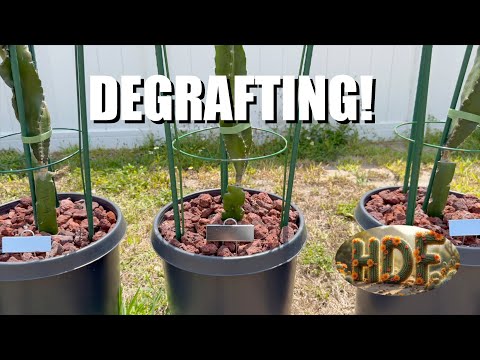
Hybridizing Dragon Fruit - DeGrafting
Hello dragon fruit enthusiasts! This is Jay, with Hybridizing Dragon Fruit, where we teach YOU how to make your very own dragon fruit varieties! Today’s tip of the day is about: DeGrafting! But, what is DeGrafting? And why is it so incredibly important? Well let me explain…
While grafting your seedling to a vigorous rootstock is an essential step in creating your new hybrid. It is important to remember that doing so is only a temporary solution to help your seedling to fruit as fast as possible. This is not meant to be permanent, though. At a certain point, in order to properly evaluate your hybrid, it must be separated from its host and allowed to form its own natural rootball.
...But why is that?… Well, when you graft to a rootstock, you get certain benefits from that rootstock. Such as weather resistance, disease & pest resistance, and even increased growth rates. For instance:
In the “Focusing Your Cutting” video we did here at HDF, I showcased an Ax that had been grafted, versus an Ax on its own natural roots. The difference… was absolutely staggering! One of the reasons the grafted version shot past the other in growth so dramatically, was not only the vigor of Halley’s Comet, but its wonderful cold resistance as well…
You see, both cuttings were started late summer, and established by fall. Ax grows very slowly and practically hibernates when the temperatures start to drop. However, Halley’s Comet does not care one bit, and continues to grow vigorously throughout the winter.
Because my Ax was grafted to Halley’s, it grew throughout the winter while the other Ax sat quietly, waiting for things to warm up… By spring, the difference in growth was enough to shoot a video over, and makes for a good example of how useful your choice of rootstock can be. It also shows just how much of an influence it can have on your plant’s traits, and how it can muddy the waters when it comes to evaluating your hybrid.
This is why at a certain point during the evaluation process, degrafting your hybrid is absolutely recommended! Only then can you see how your hybrid truly reacts to its environment on its own natural roots, being powered by its own innate engine so to speak. This is how you kick those tires and see what your plant is truly capable of.
Now, some growers like to degraft shortly into the dragon’s lifespan for an immediate evaluation. There are also those that choose to degraft after a first fruiting. Either practice is absolutely viable. However, for my circumstances, I prefer to degraft after a first fruiting. As I am evaluating many hybrids at once, this is a great way to weed them out early and make space for dragons with superior genetics.
Once degrafted, you should allow for no less than at least an entire season to pass, for a better idea of how your hybrid will react to weather conditions throughout the year. This will also give your new hybrid a chance to further mature. As the seasons go by, the fruit may and often times do change in size and flavor complexity. Some get better with age… though some do not, haha. But, this is why we are spending so much time evaluating in the first place!
If your goal is to create the best hybrids possible, it’s important to take the time to properly evaluate it on its own natural roots… in all its true glory… And degrafting is an absolutely necessary step to make that possible!
If you would like to learn more about creating your own dragonfruit hybrids, please give us a thumbs up, a subscribe, and be sure to join our Facebook group @Facebook/groups/HybridizingDragonFruit.
Grow something AMAZING!